


Linear features
Alley cropping agroforestry with coppiced tree belts (CTB)
PDF Download
Utilization of the coppicing ability of trees for biomass production, soil protection, increasing biodiversity and carbon sequestration
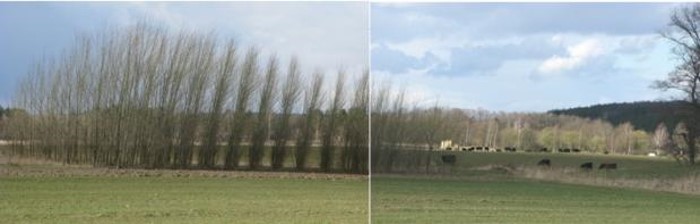
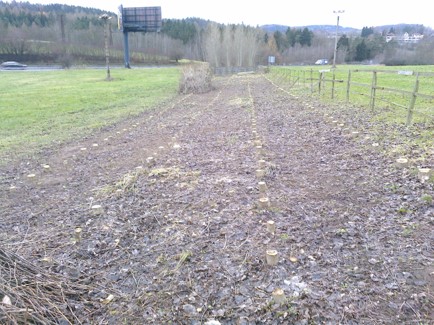
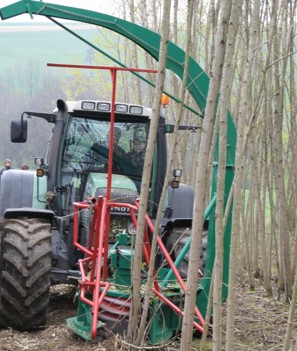
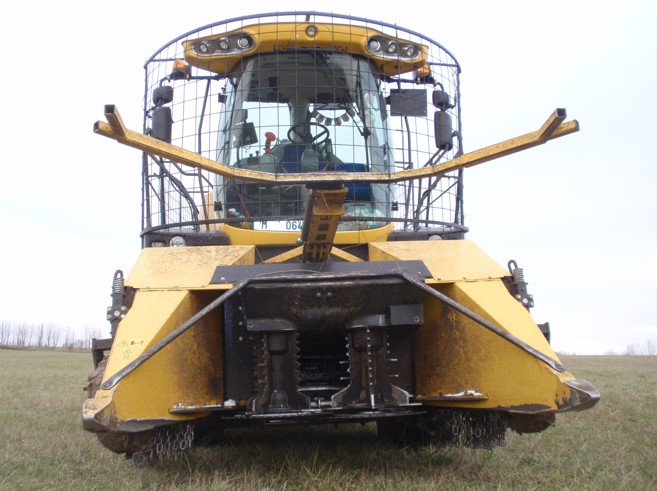
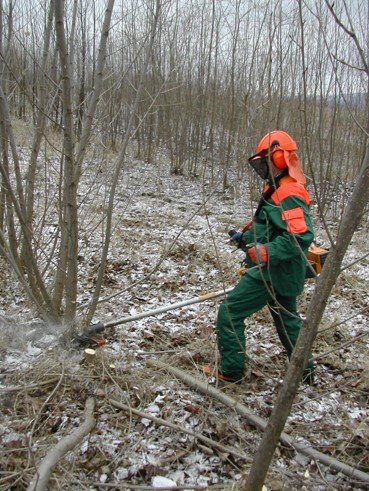
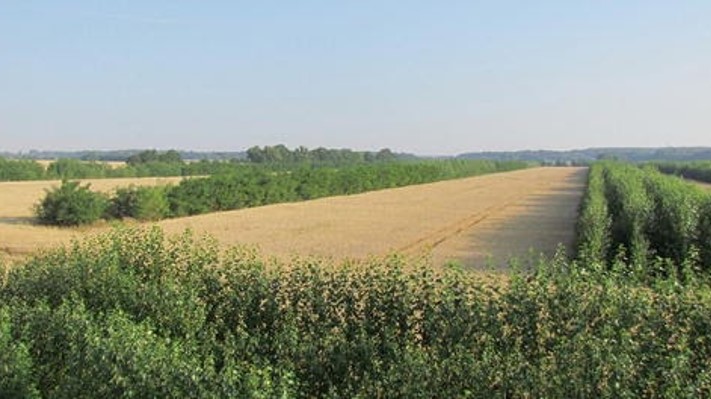
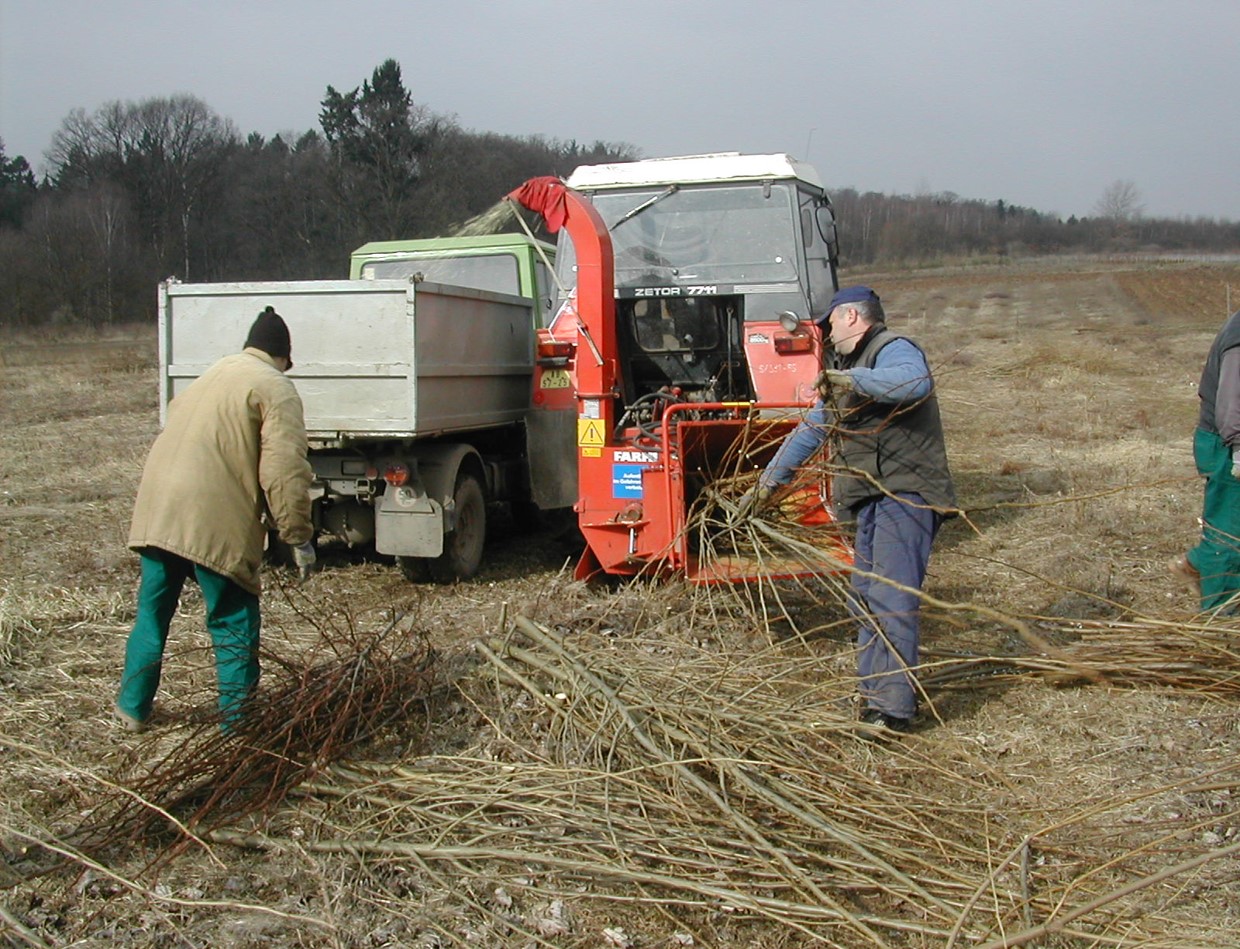
Coppiced trees belts (CTB) combine the advantages of traditional alley cropping (single rows of trees) and short rotation coppice (dense tree plantation) on agricultural field. CTBs create “hedgerows or narrow forests” with a small-forest environment, which is beneficial for many organisms (biodiversity) and effective for buffering climatic extremes (erosion, heat). Additionally, they produce demanded renewable biomass (woodchips, firewood, assortments) for local bioenergy and bioeconomy.
Agroforestry systems with coppiced trees belts can be established and cultivated in a number of variants - according to the conditions of the location and needs of the farmer. To optimize environmental
and economic benefits, the following parameters of CTB are recommended for large fields (over 20 ha):
- Have two to four rows of trees planted in scheme (1.8-2.2m) x (0.25 - 0.5m),
- Usually plant 2 to 4 belts per 1 ha at a distance of 24-40 meters, but the distance between the belts in the AFS plot depends on local situation, farmers goals and agronomy,
- Leave passages for mechanization (6 - 12 m) on the edge of the plot or in another suitable place,
- Maintain a 10-20% share of CTB of agroforestry system (field),
- Use trees species and varieties with good coppicing ability on the stump including native and introduced poplar, willow, alder, ash, oak, linden etc.,
- Use planting cuttings (or 1-year planting) that can preferably be planted with forestry or special mechanization,
- Weed (mechanically or chemically) for first six months after establishing the CTB,
- Rotation of the CTB can vary between 2 to 10 years depending on tree species and their growth, final product and market situation,
- Harvest using standard forest or farming mechanization depending on situation; for larger CTBs, the most efficient is to use a corn forage harvester with standard of special cutting head.
For planting of cuttings (or 1-year planting) it is recommended to use standard forestry planters (one, two or more lines) or special mechanization for planting of short rotation coppice.
For weeding (first six months after establishment) – mechanical methods, such as hoe, brush cutter etc. can be used for smaller CTBs (below 1 ha). For larger CTBs, pre-emergent herbicides are the best solution economically and when considering the time factor.
A forage harvester with standard respectively special cutting head can be used on tree stumps up to 15-18 cm in diameter. For larger dimensions, standard forest mechanization must be used.
Rotation (repeated harvest periods) of the coppiced trees belts (CTB) can vary between 2 to 10 years depending on tree species and their growth, final product and market situation, which gives farmers some time for optimizing production and work. The best time for harvest is winter (XII-III) when the moisture content is the lowest and trees are dormant.
Good yields of CTB would be between 15-20 tons/ha of CTB/year of fresh biomass (woodchips) on average of whole production time. Such yields can be expected on good sites for coppiced trees, e.g., well and moderately moist soils. The establishment cost for a CTB (considering the above-described scheme of 3 belts) could be around 2000 €/ha
of AFS in the current conditions in the CEE countries.
When adhering to the principles of good farming and proper site and tree selection, the economic productivity of CTBs over the approx. 20-year period of the productive life of the trees is comparable to that of annual crops.
The return on invested funds is shorter and establishment costs are lower than in many other alley cropping systems.
The CTB as such has not yet been introduced in the EU as a CAP / CAP measure, although it appears in some countries under different types and schemes. In Saxony, Wales and in the Czech Republic you can find different types or research plantations that document environmental and economic parameters of this AFS. By including CTBs in the portfolio of supported and accepted agroforestry systems, farmers will gain a multifunctional and potentially economically viable agronomic procedure that can be flexibly set up to address specific land and site situations and needs. CTBs would also be an effective adaptation and mitigation measure against the impacts of climate change.
- Publication: Ansgar Quinkenstein, Penka Tsonkova, Dirk Freese. Alley Cropping with Short Rotation Coppices in the Temperate Region: A Land-use Strategy for Optimizing Microclimate, Soil Organic Carbon and Ecosystem Service Provision of Agricultural Landscapes 263-297.
- Publication: Anita Swieter, Maren Langhof, Justine Lamerre, Jörg Michael Greef. 2019. Long-term yields of oilseed rape and winter wheat in a short rotation alley cropping agroforestry system. Agroforestry Systems 93:5, 1853-1864.
- Video: Dirk Freese: Agroforestry in Germany, International Conference "Agroforestry - Environmental and Production Alternative in Agriculture" 18.4.2019 Prague, https://youtu.be/ia0Te5R-_10 (from 1:20:45)
 | Mr Jan Weger and Department of Phytoenergy Silva Tarouca Research Institute for Landscape and Ornamental Gardening weger@vukoz.cz |


