


Linear features
Riparian Buffer Zone. Planting trees and shrubs on both sides of the bank
PDF Download
How to plant and maintain riverbank vegetation for best results

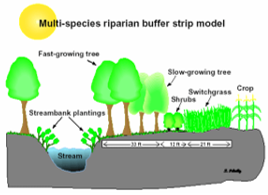
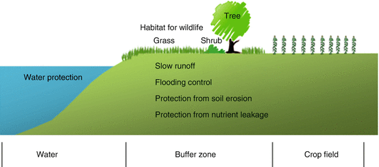
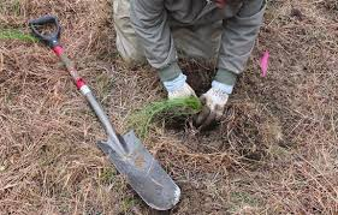
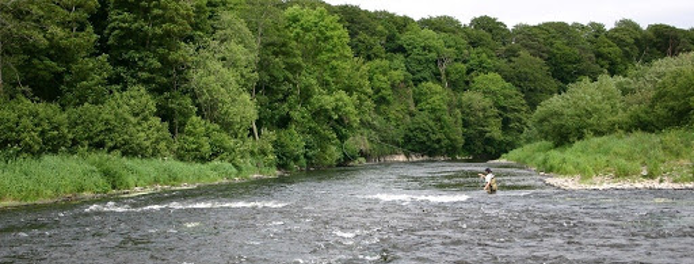
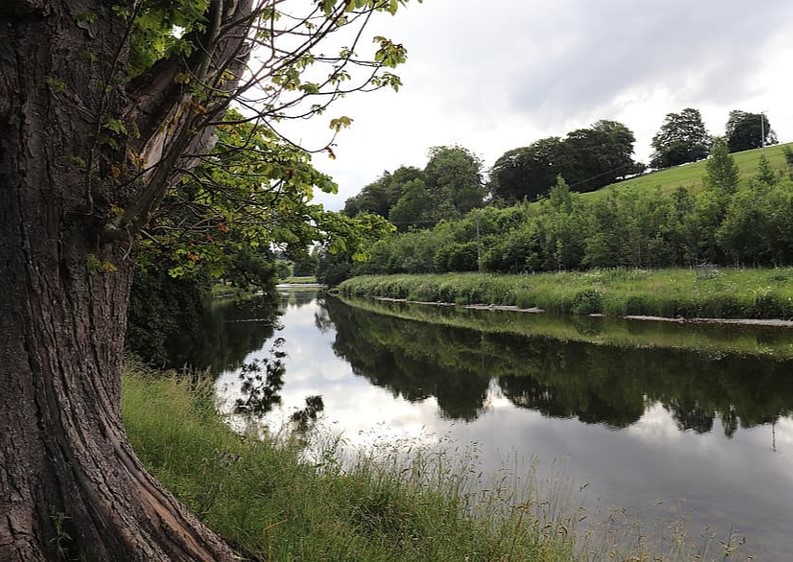
The objective is to protect rivers and the ecosystem services it provides whilst also making the practice productive. A Riparian Buffer protects both the health of the river and the fertility of the land. Amongst many other benefits, they preserve water from heating too much, banks from eroding too fast and support freshwater life. Naturally, through protecting both the river and land, they will provide ecosystem services. Well managed, a Riparian buffer can be made productive itself.
Establishment Method:
If there is vegetation already on the site then you can base the buffer strip on what already exists. Naturally regenerating species will enhance the strip and maintain its prominence without intervention but it is often wise to plant other plants which might complement the existing species. However, if the existing vegetation are invasive species which would compete with desired saplings, then it would be best to remove them.
Fencing should be avoided as much as possible since it is impractical on almost all sites, and dangerous
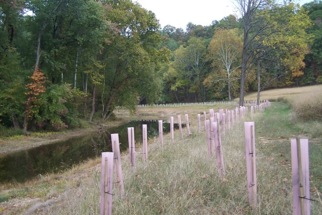
in case of flooding. On bare banks, establishing the buffer means planting saplings with a good digging spade and using tree guards to protect against deer, rabbits and sheep amongst other animals.
Species of choice:
Native species which can adapt easily to the local water and soil are best suited. Trees and shrubs which do well on river banks such as willow are good choices.
Width:
Depending on the size of the stream, the width of the riparian zone will change. For a river of 1m wide the stream should be from at least 5 meters on each side of the bank, for a river of from 1 meter to 2 meters of width the buffer zone should be between 10 and 20 meters large. For any stream larger than 2 meters, 20 meters on each side of the bank would be the ideal size.
Canopy Structure:
There is a need for a mix between large tall trees bringing shade to the river and some smaller trees so that the sunlight can still pass through. To reach the ideal vegetative status we need to implement a mix
of 5 vegetation structural habitats: open grounds, occasional large trees, trees with open glades, scrub thicket, and a closed woodland canopy.
In theory, Riparian buffer establishment would require relatively inexpensive and extremely accessible tools. For soil preparation, (if required) a garden fork or hoe would suffice for €30. For digging, a good spade made with a wooden handle and steel head would cost around €30 as well. To protect the tress, standard maintenance might include tree guards, with their cost depending on the material and amount. Usually, for large scale planting, cheaper tree guards made from plastic are the best option and cost, when bought in bulk, e.g. €28 for 100 spiral 60cm tree guards.
Generally, it is a matter of tools rather than machinery, and other digging tools would include
a dibble/planting bar, which would cost around €50.
Riparian Buffer zones should be managed at least every 5 years, it’s the perfect time frame to review the woodland conditions and to check at the progress made in newly built buffer zones. The central questions are the assessment of the evolution of the shade above the river, and the recognition of the need for beating up, thinning or felling of undesirable conifer trees growing inside the buffer zone.
On an annual time length, cutting should not be done between March and August to avoid disturbing nesting birds.
Any felling done within the buffer zone should be carefully planned to avoid site disturbance carried out by heavy machineries.
The total cost of riparian buffer strips is generally low for both establishment and maintenance. Establishment costs primarily come from the purchase of the plants and trees, either as seedlings (less expensive) or more mature trees. Tools including spades, planting bars, planting hoes and dibbles, cost between €30 - €50 each. Costs for the establishment are of course dependent on how much land is to be converted into riparian buffer zones. Time is also dependent on this factor although it can also depend on labour.
The species of tree is subject to the site, but to give an example of popular species, poplar saplings would cost in the region of €120 per 100 and Willow saplings would be the same price too per 100.
With a mortality rate of 10%, further planting may be required should prominent gaps emerge in the buffer. Maintenance otherwise is relatively low cost.
Economic benefits include diversification crops should trees such as walnut or hazelnut be incorporated into the strip for example. Land becomes more valuable due to greater soil quality.
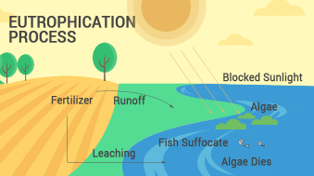
On the River Blackwater in County Waterford, Ireland, the middle and lower courses of the river are often between agricultural land. The land uses vary from Intensive dairy farming, livestock grazing and forage harvesting. Usually these practices are relatively intensive and include the use of nitrogen fertilizers. The terrestrial farming activities have a large impact on the river’s health. Notably eutrophication occurs in the parts of the river barer and more susceptible to run off from farmland. Oxygen depletion which threatens freshwater life in the river is a direct consequence of the algal blooms caused by runoff and leaching. Many farmers along the banks have taken note of the natural buffer strips along the river which are protected by banks too steep to farm on. With a desire to retain their fertile soil and to protect the river, managed riparian strip buffers have been enhanced or planted along the banks. Often it is a case of planting more around existing small natural buffers and making them more prominent.
- Video: What is RIPARIAN ZONE? What does RIPARIAN ZONE mean? RIPARIAN ZONE meaning, definition & explanation https://www.youtube.com/watch?v=z8MP5J_Ivs0
- Video: Defining Riparian Buffer https://www.youtube.com/watch?v=2p_vGJtY6Eg
- Video: Riparian management: Increasing biodiversity on farms https://www.youtube.com/watch?v=YiaxoTkhnBA
- Video: A new type of river management is coming! https://www.youtube.com/watch?v=21YAP8RF_sw
 | Mr Antoine de Theux / Robert Evans-Bevan European Landowners Organisation 67 rue de Trèves B – 1040 Bruxelles Belgium robert.evans-bevan@elo.org |


