


Farm Miller Holubice
Download PDF
Basic information
| Year of foundation | 1993 |
| Specialization | Crop production (cereals, rape, sugar beet and feed crops) Cattle breeding with milk production |
| Farm area | 880 ha |
| Number of employees | 12 |
| Year of starting agroforestry practices | 2018 |
| Location | Svrkyně 103, Prague West |
| Webpage | www.farma-miller.cz |
Farm Miller Holubice
Miller family has been living and farming in the village of Holubice and its surroundings since approximately the 17th century. Since that date, apart the period of collectivization in 1951-92, a Miller has always been privately farmed on this farm. At present, the Jan Miller family manages approximately 880 ha of mainly arable land with a focus on intensive cultivation of cereals, sugar beet, rape and fodder crops. The farm is also focused on dairy cattle breeding (approx. 350 animals As the farm is a typical example of a family farm with a very intensive farming, Jan himself sees some of the negative effects of this type of farming, such as erosion, loss of soil fertility, biodiversity reduction, etc. Therefore, in 2018, in cooperation with the Czech University of Life Sciences (CULS), he decided to set up an experimental agroforestry system on arable land on a part of his land (2.5 ha). It is a linear planting of trees in combination with the classical cultivation of other crops on arable land (so-called alley cropping).
The farm is an example of a large family farm with intensive agricultural production. Cereals (wheat, barley), sugar beet, oilseed rape and fodder crops (alfalfa, clover grass, maize, etc.) are grown on most of arable land. Furthermore, Jan Miller built a very modern cowshed for dairy cows (150 Holstein and Jersey dairy cows, 200 young cattle) on the farm. Part of the family manages 60 hectares of orchards in the surrounding villages and runs the guest house.
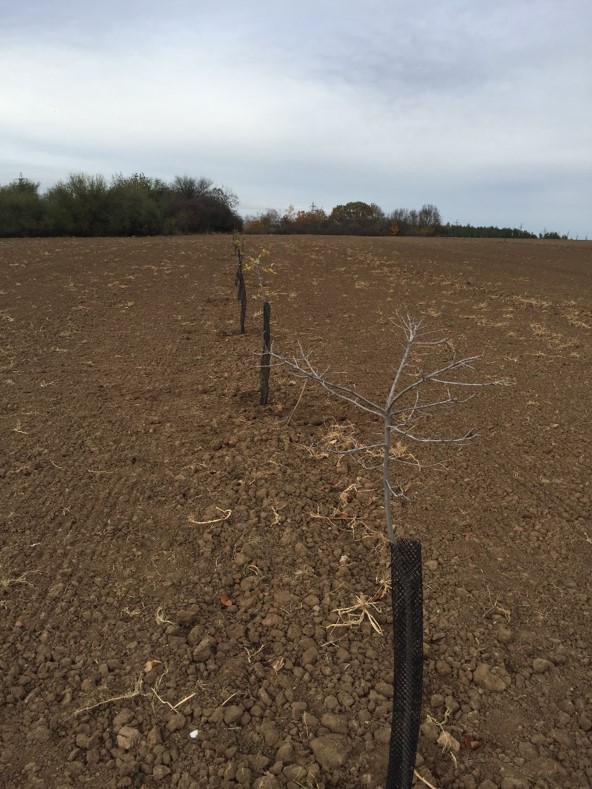
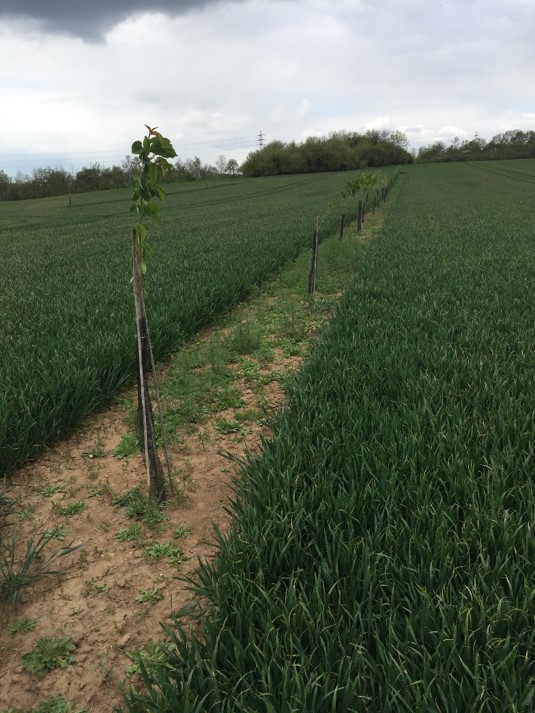
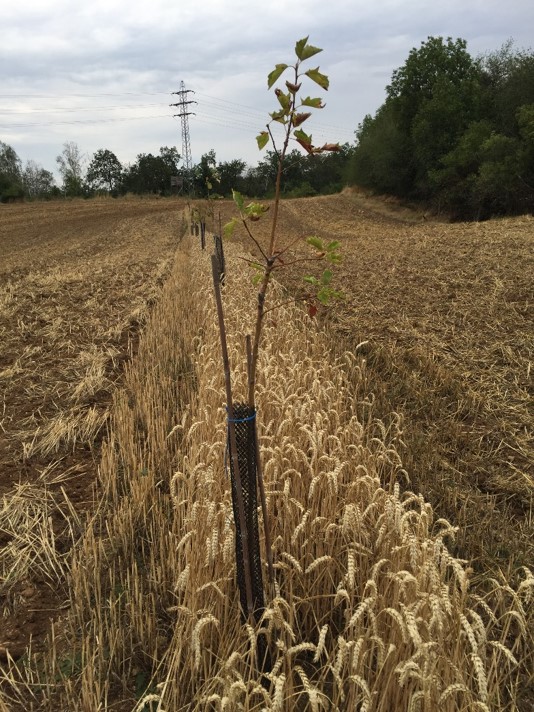
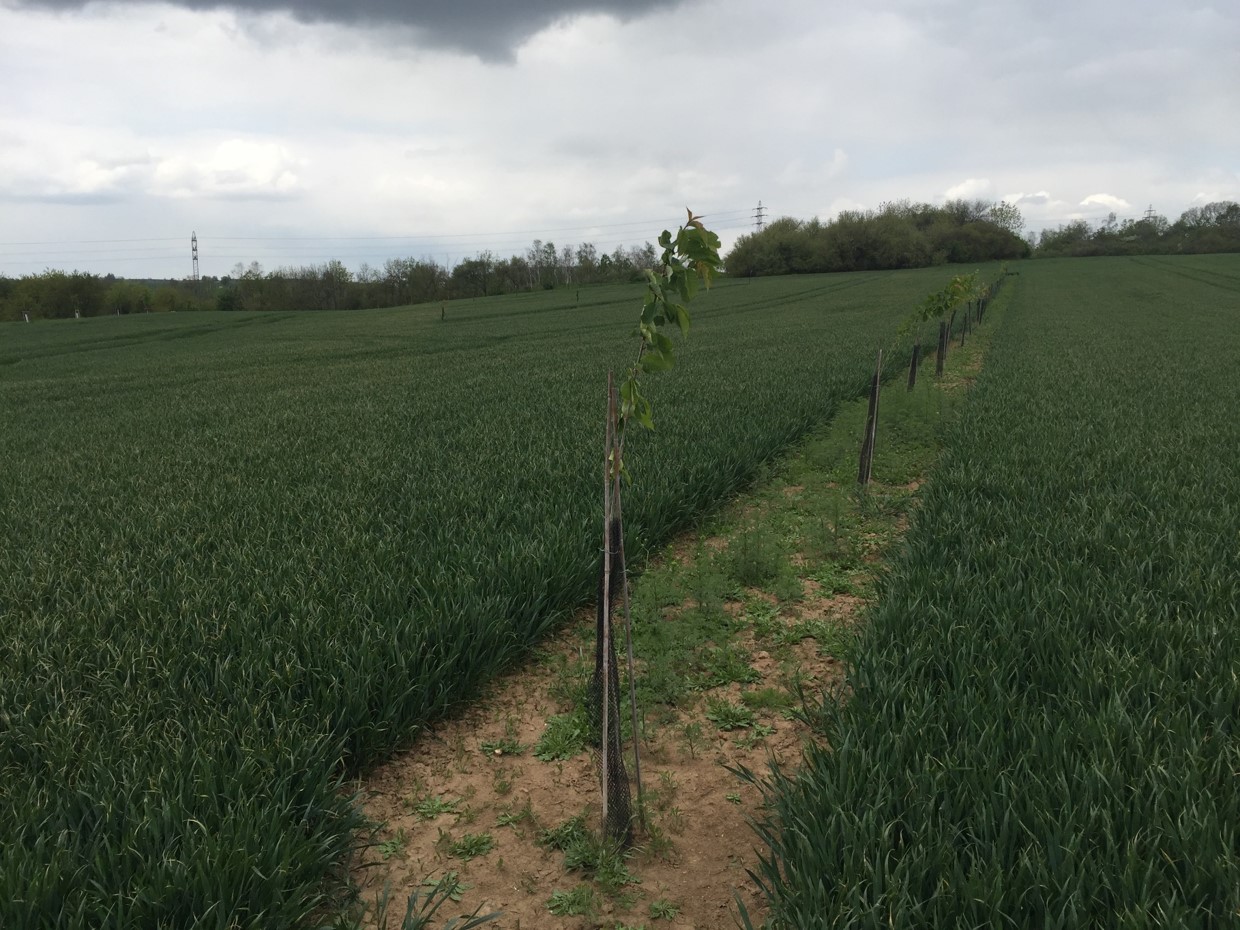
In 2018, an agroforestry plot with a total area of about 2.5 ha was established on arable land in Úholičky. It is arable land of worse quality. The aim of the study plot establishement is to determine the possibility of linear tree planting on arable land (so-called alley cropping) and evaluate its impact on production (crop yields, tree growth) and non-production functions (water retention, soil fertility improvement, biodiversity protection, etc.). It is the first agroforestry area on the farm.
- The agroforestry plot was established a year ago and therefore there are not results of the research yet. The growth and survival of tree species and their agri-environmental impacts will be monitored on this area.
- Jan expects from the established agroforestry area mainly diversification and division of intensive agricultural land, higher water retention in the landscape, game return and last but not least economic income from trees in the long term (quality wood, wood chips, etc.)
Agroforestry systems were established in cooperation with researchers from CULS and The Silva Tarouca Research Institute for Landscape and Ornamental Gardening Průhonice (RILOG). Suitable woody species were selected and suitable agroforestry design was proposed so that ordinary agricultural production could be operated between tree lines. Jan Miller takes it as a test of what can work in such conditions, what trees can grow there, how difficult it is to care about them after the planting, how they tolerate drought, etc. This study is carried out in fields with poorer production potential, where classical plant production is not very profitable. Planting and maintenance was carried out with the support of the project from TAČR éta program.
The family has experience in growing trees in orchards. Jan Miller also attended a course on Agroforestry, which took place at the CULS in Prague in 2017.
Description of used technics during establishing of agroforestry systems
Alley cropping on about 2.5 ha. Planted tree species – common aspen, grey poplar, wild service tree, wild cherry, sessile oak. Black walnut nuts were sowed in the lines. The lines of fast growing poplars and willows were planted with cuttings. Distance between lines is 25.5 m, tree spacing is 3-5 m.
Threats/Challenges
The family has experience in growing trees in orchards. Jan Miller also attended a course on Agroforestry, which took place at the CULS in Prague in 2017.
Description of used technics during establishing of agroforestry systems
Alley cropping on about 2.5 ha. Planted tree species – common aspen, grey poplar, wild service tree, wild cherry, sessile oak. Black walnut nuts were sowed in the lines. The lines of fast growing poplars and willows were planted with cuttings. Distance between lines is 25.5 m, tree spacing is 3-5 m.
Threats/Challenges
- It would be useful to develop a methodology for establishing and maintaining agroforestry systems.
- Jan Miller also recommends training organized by the Association of Private Agriculture.
- The biggest threat is currently drought after planting. Fast growing trees were planted for the first time in the spring of 2018, but after a very dry summer, most of cuttings dried up. Planting of fast-growing tree species and seedlings was then repeated in autumn 2018. In the spring, watering was carried out several times and the tree survival s currently under evaluation.
- Another problem is the escape of herbicides from nearby crop production, which has a negative effect especially on fast growing trees in the first stages of growth.
- Important is also the protection of trees against game biting (individual protection - plastic mesh).
Jan's farm was the first experiment of a larger scale to introduce alley cropping in the Czech Republic. The design of the agroforestry system has been adapted to the intensive crop production and over the years both the production parameters of trees and crops and the environmental effects of trees will be monitored. This test should show which trees are more tolerant of drought, which grow well on arable land, and how care for these trees in the first years after planting.
Future plans
If the experiment will be successful, Jan would like to extend agroforestry systems to other areas. The alley cropping could also take place within the framework of land planning and could be implemented by both landowners and municipalities.
Future plans
If the experiment will be successful, Jan would like to extend agroforestry systems to other areas. The alley cropping could also take place within the framework of land planning and could be implemented by both landowners and municipalities.
Farmer recommendation: „First try everything: suitable trees, suitable design, tree maintenance, etc.“


