


Individual features
Planting and management of trees on arable land (silvoarable systems)
Download PDF
How to plant trees correctly – when, how and what to do
Warning: Imagick::readImage(): stream does not support seeking in /data/www/22790/agroforestrysystems_eu/www/wp-includes/class-wp-image-editor-imagick.php on line 155
Warning: Imagick::readImage(): stream does not support seeking in /data/www/22790/agroforestrysystems_eu/www/wp-includes/class-wp-image-editor-imagick.php on line 155
Warning: Imagick::readImage(): stream does not support seeking in /data/www/22790/agroforestrysystems_eu/www/wp-includes/class-wp-image-editor-imagick.php on line 155
Warning: Imagick::readImage(): stream does not support seeking in /data/www/22790/agroforestrysystems_eu/www/wp-includes/class-wp-image-editor-imagick.php on line 155
Warning: Imagick::readImage(): stream does not support seeking in /data/www/22790/agroforestrysystems_eu/www/wp-includes/class-wp-image-editor-imagick.php on line 155
Warning: Imagick::readImage(): stream does not support seeking in /data/www/22790/agroforestrysystems_eu/www/wp-includes/class-wp-image-editor-imagick.php on line 155
Warning: Imagick::readImage(): stream does not support seeking in /data/www/22790/agroforestrysystems_eu/www/wp-includes/class-wp-image-editor-imagick.php on line 155
Warning: Imagick::readImage(): stream does not support seeking in /data/www/22790/agroforestrysystems_eu/www/wp-includes/class-wp-image-editor-imagick.php on line 155
Warning: Imagick::readImage(): stream does not support seeking in /data/www/22790/agroforestrysystems_eu/www/wp-includes/class-wp-image-editor-imagick.php on line 155
Warning: Imagick::readImage(): stream does not support seeking in /data/www/22790/agroforestrysystems_eu/www/wp-includes/class-wp-image-editor-imagick.php on line 155
Warning: Imagick::readImage(): stream does not support seeking in /data/www/22790/agroforestrysystems_eu/www/wp-includes/class-wp-image-editor-imagick.php on line 155
Warning: Imagick::readImage(): stream does not support seeking in /data/www/22790/agroforestrysystems_eu/www/wp-includes/class-wp-image-editor-imagick.php on line 155
Based on this practice we expect a higher survival rate of artificially regenerated trees (planted trees), creating optimum conditions for long-term growth in the habitat, managing trees for the best trunk and crown growth (for wood or fruit production).
- Treatment of the tree seedlings before planting. Take the ground pack out of the container or cloth bag. Check the damage of branches. Cut damaged branches. Cut side branches by 1/3 of length. The terminal pointing upwards is rarely cut.
- Soil and substrate. Plants should not be planted in a pure horticultural substrate. Ideally mix the substrate with the original soil. In the case of poor soil, it is recommended to replace at least 50% of the original soil.
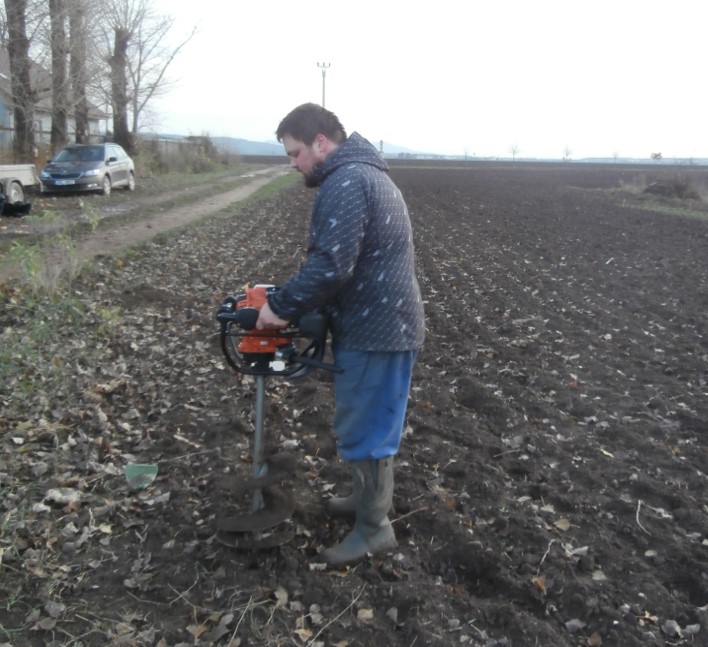
- Tree planting. Locate the center of the hole where the tree will be planted. The excavated hole will be about 10 to 15 cm wider than the tree bulk. Depth of hole by balk. Pour soil with a substrate or loose soil on the bottom of the hole. We plant the tree to the level in which it was grown. During backfilling, we adequately compact by pedaling to avoid air pockets. In plants from the container, the root system is disrupted from all sides by a spade.
- The tree trunk can be white painted or covered with a jute bandage.
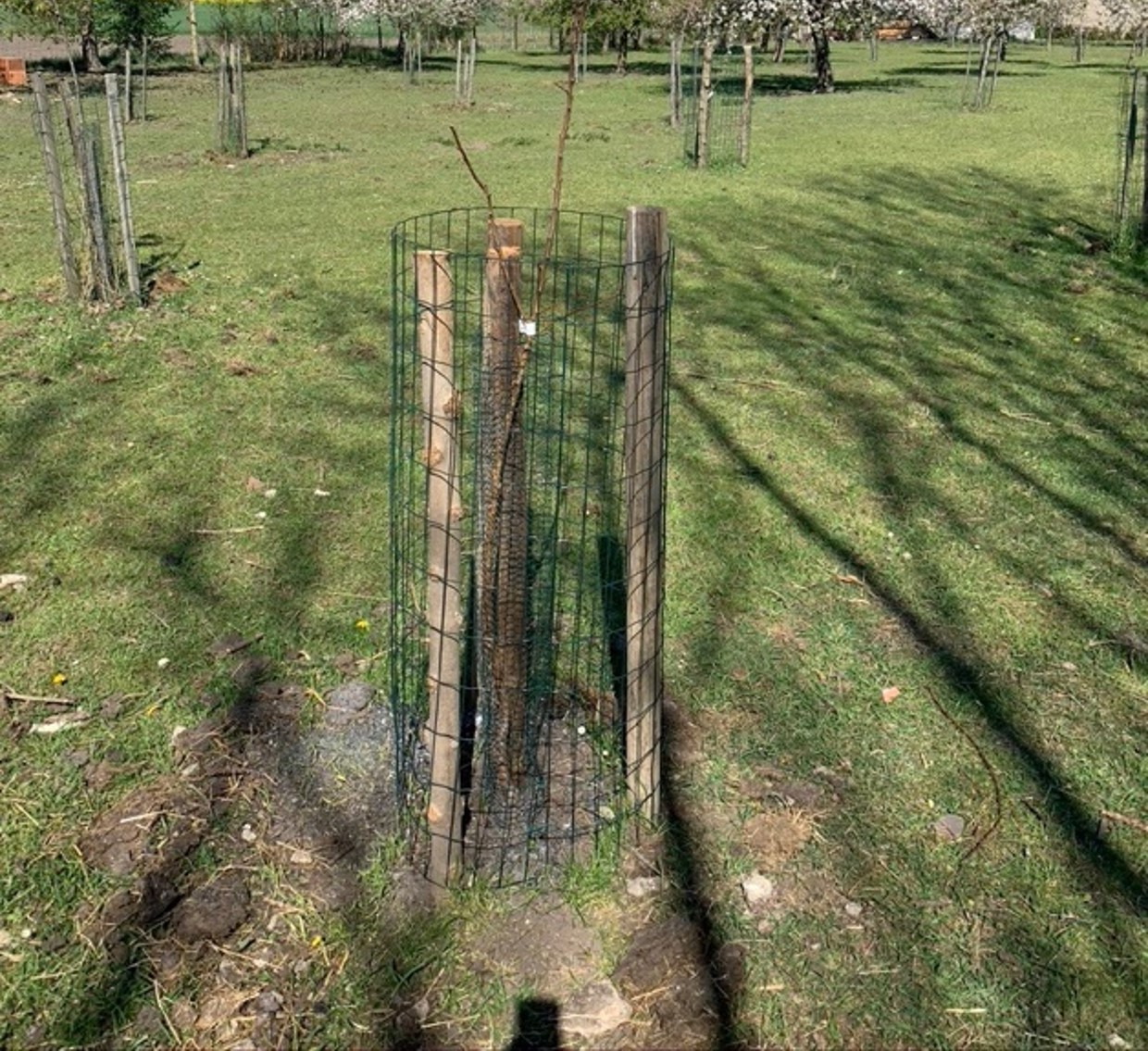
- Anchoring the tree using stakes. In the case of larger trees, a system of three wooden stakes is often used, which are connected by partition walls in the upper part. But we can also anchor with two stakes. We strike the stakes outside the tree balk. The tree must be tied firmly and straight! Smaller tree we attach to one stake. Hammer the pole vertically or diagonally. At the place where the stake touches the trunk, wrap the trunk with a jute strip.
- For larger trees, create a watering bowl.
- Protection of young trees. Trees suffers by competition of vegetation and by attack of animals. Attaching a plastic bite guard around the trunk, or a bite coating. To protect against aggressive vegetation selective mulch can be recommended. Finally, use a lot of water.
- Main care after planting is to ensure sufficient watering. Check the strangulation or release of harness of the tree trunk. Moving around plants at least once a year.
Materials:
Tree with earth balk (e.g. Ø12-14, height 450 cm, or tall pieces 120 cm high), 3 stakes of static securing, 1 halved pole to create partitions, (or oak stakes of 5 x 5 cm and length 2 m), 2.5 m lashing strap, plastic bite guard, Aversol spray, jute bandage
Tool:
Spade, (possibly pickaxe, shovel), hammer or hammer, hammer, saw, shears, secateurs, nails size 80-100 mm, nails with large head approx. 30-40 mm (cardboard), band, watering can or other water tank (at least approx. 15 - 20 litres of water per tree needed)
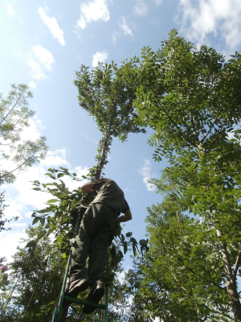
The best time for tree planting is late autumn, other possibility is during wintertime (only if the soil is not frozen) or early spring. The most common time for planting is October to April (bare root seedlings - October to March, root ball seedlings October to May, seedlings in containers October to summer). The tree crown establishment is recommended after planting – a foundation cut is made. This is the basis for formation of the crown into typical habit or functional type. Periodically you can make a maintenance cuts (depend on forest vs. fruit trees). For formation of the straight trunk of forest trees, pruning of the lower branches periodically every year is of substantial importance.
Establishment cost is very variable depending on site conditions, species and planting material.
The cost of seedling varies greatly on the age and size of the seedling, if the seedling is bare rooted or with the soil bulk and also fruit vs. forest trees. In general, the older and taller the seedling the higher the cost, fruit trees are usually more expensive and trees with soil bulk are more expensive that bare-root seedlings. The cost of the seedling could start on few EUR (bare root, young, forest trees) up to 50 EUR or more for 2 m tall, well developed, 3-5 years old fruit tree like chestnut. Costs for planting is usually lower compare to cost for protection against animals (poles and meshes), watering (if necessary) and protection against weeds (mowing, mulching).
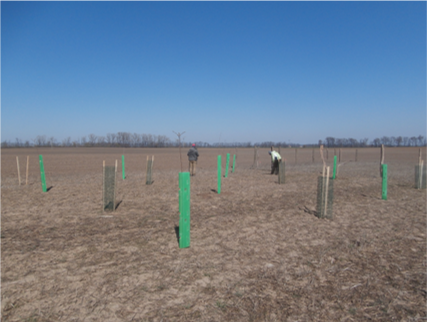
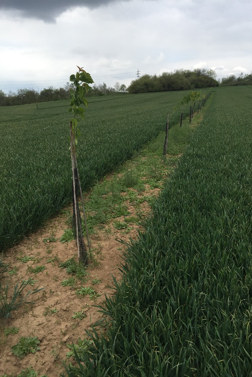
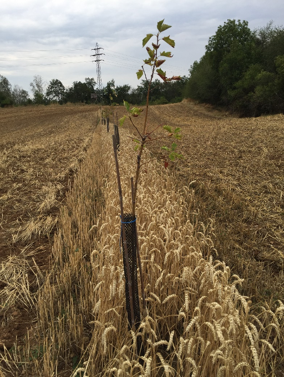
In 2018, an agroforestry plot with a total area of about 2.5 ha was established on arable land in Úholičky, Czechia. The plot was established by cooperation of the farmer Jan Miller and Czech University of Life Sciences. The farmer chose an arable land of poor quality. The aim of the study plot establishment is to determine the possibility of linear tree planting on arable land (so-called alley cropping) and evaluate its impact on production (crop yields, tree growth) and non-production functions (water retention, soil fertility improvement, biodiversity protection, etc.). Planted tree species were common aspen, grey poplar, wild service tree, wild cherry, sessile oak. Black walnut nuts were sowed in the lines. The lines of fast-growing poplars and willows were planted with cuttings. Distance between lines is 25.5 m, tree spacing is 3-5 m. The survival rate of the trees during first year was around 70%, due to the drought in summer. The trees were replanted the following year. The total costs for tree establishment during first two years were around 5,000 EUR.
 | Mr Daniel Preininger, Mr Bohdan Lojka Czech University of Life Sciences Prague danpr88@gmail.com | lojka@ftz.czu.cz Mr Antonín Martiník Mendel University Brno martinik@mendelu.cz |


